Retrospective Review of Interstellar (2014): A Cinematic Masterpiece That Transcends Time
Nearly a decade after its release, Christopher Nolan’s Interstellar (2014) remains one of the most iconic and divisive films in modern science fiction cinema. Upon its debut, Interstellar received praise for its grand ambition, stunning visuals, and deep emotional core, while also facing criticism for its dense scientific concepts and narrative complexity. However, as time has passed, the film has earned a more reflective appreciation as a bold exploration of humanity’s place in the universe. Looking back, Interstellar is not merely a story about space travel but a meditation on love, survival, and the delicate interplay between science and human emotion.
Plot Overview: Humanity’s Last Hope
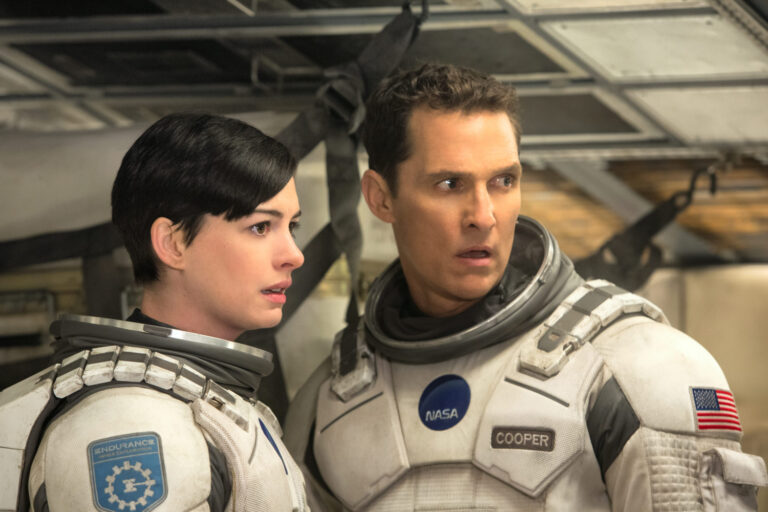
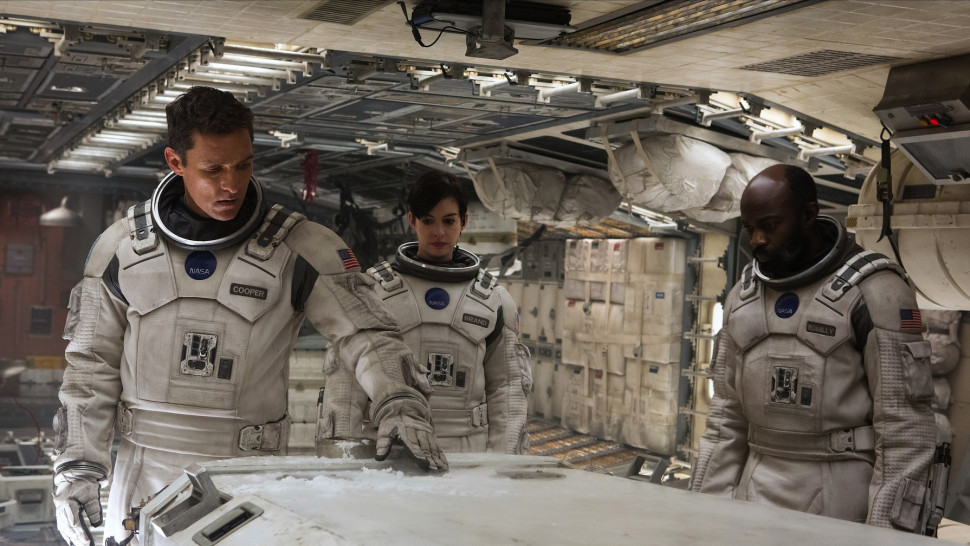
In Interstellar, Earth is slowly dying. Blight has ravaged crops, leading to widespread famine and environmental collapse. The planet’s once-thriving civilizations have turned to subsistence farming, but it’s clear that humanity is on the verge of extinction. Former NASA pilot Joseph Cooper (Matthew McConaughey) is recruited by a secret branch of NASA to pilot the most critical mission in human history: a voyage through a newly discovered wormhole near Saturn that could lead to habitable planets.
Cooper, torn between his duty to save humanity and his love for his children—especially his daughter Murph (Mackenzie Foy, later Jessica Chastain)—sets off with a team of scientists that includes Amelia Brand (Anne Hathaway). Their goal is to search for a new home for humanity among the stars. But their journey through space, time, and the laws of physics uncovers unimaginable challenges and revelations about the universe and themselves.
A Visionary Film: Ambitious in Scope and Theme
Viewed retrospectively, Interstellar emerges as one of Nolan’s most ambitious films, both in terms of scale and thematic depth. Nolan’s vision transcends the traditional boundaries of science fiction. Where most films focus on the spectacle of space exploration, Interstellar looks inward, exploring the emotional weight of such a journey and how it resonates with deeply human experiences.
At its heart, Interstellar is about survival—not only the survival of a species but the survival of love, hope, and the connections that define our existence. The film asks fundamental questions: What makes humanity worth saving? How do we reconcile our need to explore the unknown with our longing to stay connected to those we love? These questions remain central to the film’s lasting impact.
The Relationship Between Love and Science: A Controversial but Thought-Provoking Core
One of the most debated aspects of Interstellar upon its release—and a topic that still divides viewers today—is its portrayal of love as a transcendent force. In a crucial scene, Amelia Brand argues that love is not bound by the laws of physics. She proposes that it might be an element of the universe as fundamental as gravity, suggesting that love can guide human decisions across space and time.
For some, this concept seemed overly sentimental in a film built around the hard realities of space and time travel. Others, however, saw it as one of Nolan’s most profound statements, positioning love as a unifying theme in a story that spans galaxies. Looking back, this idea has aged well, especially in a world where isolation and distance—both physical and emotional—are more relevant than ever.
In many ways, Interstellar remains ahead of its time in its philosophical exploration of how science and emotion intersect. While it delves into black holes, wormholes, and time dilation, the heart of the film is not found in its scientific theories but in the emotional ties that bind its characters across vast distances.
The Passage of Time: A Central Theme That Resonates
Interstellar is ultimately a film about time, both literally and figuratively. As Cooper and his team navigate different planets, they encounter situations where time moves at different rates. The most poignant example is when Cooper and Brand visit a planet where every hour equals seven Earth years. By the time they return to their ship, Cooper’s children have aged dramatically, while he has barely aged at all. The weight of lost time is felt most acutely in the scene where Cooper watches years’ worth of video messages from his children, now grown adults, in a devastating sequence that has since become one of the film’s most memorable and emotionally wrenching moments.
Upon reflection, this treatment of time emphasizes the film’s broader themes: that time is both a gift and a curse. For Cooper, time is the enemy, constantly pulling him away from the ones he loves. For Murph, it is a force she wishes to harness, driven by her desire to reunite with her father and solve the problems threatening Earth. The manipulation of time is not only a scientific concept in Interstellar but also an emotional device that drives the narrative forward, reminding us that time is one of the few things we cannot control.
Visual Mastery: Still Awe-Inspiring After a Decade
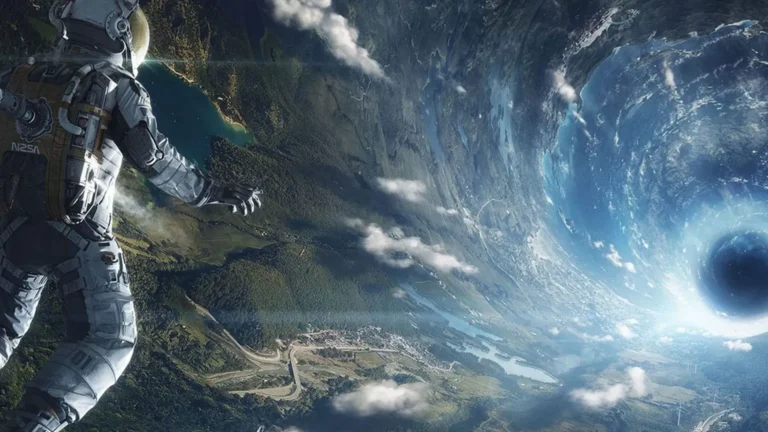
Visually, Interstellar remains as awe-inspiring today as it was upon its release. Nolan’s use of practical effects, combined with state-of-the-art CGI, creates a truly immersive experience. The depiction of space is both terrifying and beautiful, presenting a realistic portrayal of the void that surrounds our planet.
One of the film’s most enduring visual achievements is the rendering of the black hole, Gargantua. With the help of theoretical physicist Kip Thorne, Nolan’s team crafted a scientifically accurate depiction of a black hole, showing light bending around its immense gravitational pull. This image, both mysterious and majestic, has since become iconic in the realm of cinematic space imagery. In retrospect, this black hole serves as a symbol of both the unknown and the infinite, key themes of the film.
Additionally, the contrasting beauty of the alien planets—one a frozen wasteland, another an endless ocean—evokes the harsh realities of space exploration. Each world is a stark reminder that while the universe is vast, it is also largely inhospitable. The visuals, enhanced by Hoyte van Hoytema’s cinematography, create a sense of scale and isolation that remains unparalleled in modern science fiction cinema.
Hans Zimmer’s Score: A Timeless Soundtrack
Looking back, one cannot discuss Interstellar without acknowledging Hans Zimmer’s iconic score. The music, characterized by the haunting tones of the organ, is as much a part of the film’s identity as its visuals. Zimmer’s score is both grand and intimate, perfectly complementing the film’s exploration of space and time.
Zimmer’s use of the organ, an instrument traditionally associated with churches, adds a spiritual dimension to the film. The music underscores the vastness of the universe while also reflecting the deeply personal stakes of Cooper’s journey. In retrospect, the score is one of the most influential aspects of Interstellar, and it continues to resonate with audiences long after the final credits have rolled.
A Flawed but Ambitious Narrative: The Film’s Lasting Impact
While Interstellar has aged well in many respects, it’s important to recognize that the film is not without its flaws. Some of its scientific explanations, particularly in the third act involving the Tesseract and the concept of love transcending time and space, were divisive at the time of its release and remain so today. For some viewers, these elements veer too far into the realm of speculation, disrupting the careful balance between science and emotion that the rest of the film maintains.
Yet, these narrative risks are also what make Interstellar such a unique and memorable film. In a genre often dominated by special effects and action sequences, Nolan chose to push the boundaries of what a science fiction film could be. He made a film that was as much about the human condition as it was about space exploration, and in doing so, he created something that has continued to provoke discussion, debate, and admiration.
Conclusion: A Modern Sci-Fi Classic
In hindsight, Interstellar stands as one of Christopher Nolan’s most daring films. Its ambition, both in terms of scientific accuracy and emotional storytelling, has allowed it to endure as a modern classic of science fiction. While its flaws are apparent, they are overshadowed by the film’s breathtaking visuals, profound emotional moments, and thought-provoking themes.
Interstellar is not just a film about space exploration; it’s a film about the human spirit—our drive to explore, to survive, and to love. A decade later, it remains as powerful, awe-inspiring, and emotionally resonant as ever, a testament to Nolan’s ability to craft stories that challenge us to think, feel, and dream.